Adoptive mother: Tough parenting moments

Most days I love being a parent, however, like most anything in life, there are days that I ask myself the question, “Am I really cut out for this?” Yesterday, in particular I was asking myself that of being a parent. Two noteworthy things happened that crushed my heart.

First, my beautiful, sweet, innocent little boy barely avoided an incident in school where he would have gotten really hurt by his classmates – not physically but mentally hurt (the WORST kind of pain in my opinion.)

The incident began with a simple homework assignment given a few days ago to all the preschoolers in my son’s class by his preschool teacher. Each student was to make a bag for a school friend (or two, or three, the assignment wasn’t specific) filled with trinkets inside of the child’s choosing to give to their friends to help cheer them up if they were sad. They were to sign the bag so the friend knew who it came from. My immediate thought in reading over this homework was, “Uh oh, what happens if someone doesn’t get one?” I had no idea if anyone in his class considers my son a friend despite the fact that he talks about a couple of people in the class an awful lot. I was worried. But I thought, surely the teacher will have a plan for students that might not get picked by their classmates and I went on to help my son make bags for three of his classmates and hoped for the best.

Yesterday was the day the bags were distributed. The teacher called each child up to the front of the class individually to give their bag(s) to their chosen friend(s). I was horrified after only just a couple of minutes because it quickly felt like a popularity contest in preschool, a place where children just begin to form friendships. I couldn’t believe this was happening and that I could do nothing about it but helplessly watch the whole thing play out. I watched in dismay as kids who I knew were friends with each other exchanged bags between them. I observed in agony as some children began getting multiple bags while others sat patiently waiting for their turn to get just one package. My heart ached when the boy who my son always talks about gave his bag to someone different. After ten minutes of watching this my son asked me quietly, “Mommy when will I get my bag?” I painfully answered “I don’t know honey.” I later breathed a great sigh of relief when Frank (thank GOD for Frank – a name I’ve not once heard my son mention) kindly gave my son a bag after being nudged to do so by the teacher. A minute later my heart was pained again when the teacher announced that all the bags were given out and the innocent little boy sitting next to me sadly called out that he didn’t get one. I did talk to the teacher after the fact and found out that the boy was not forgotten after all since she did indeed have a bag for him in her office given to him by a girl that was not in school that day. Regardless, the entire incident was heart wrenching. After talking with his teacher later I found out that the exercise didn’t turn out at all the way she’d intended it to. Apparently it was supposed to be an exercise in empathy where children made bags that would be kept in her office and later be given out to classmates by individual children when a child was hurt or sad. Unfortunately the directions to the assignment were not clear and many parents addressed the bags “to” someone, therefore her plan was thwarted and she felt at that point she just needed to pass out the bags.

The second unsettling incident that happened yesterday followed the awful bag giving incident by mere minutes. As my son and I were walking out of school on the sidewalk in front of the parking lot a very unexpected statement was shouted over to me by a boy of about 10 years old whom I met once only briefly (he is a brother of one of my son’s classmates), “I know that he’s adopted,” he yelled to me as he pointed to my son, “my mother told me.” This he belted out, in front of my son, my son’s classmates and their parents in a tone that was not at all different than that of someone yelling outside of a courtroom, “You’re guilty and should be ashamed!” Or at least that is how I heard it.

I didn’t know what to say. I was shocked. Purely shocked. WHY would this be mentioned now, and not just mentioned but yelled across the school yard as if it were a horrible thing, and by a sibling of a kid attending our son’s preschool? I managed to wave his way and casually say, “That’s right.”    

Even though our son’s adoption is not a secret and he knows where he came from, I don’t like knowing that some kids and people throughout his life will talk about him behind his back and and make comments to him or around him about his being adopted, especially if it has a negative connotation to it which might make my son feel like his being adopted is a bad or shameful thing. I had never yet experienced this side of adoption firsthand and I felt slightly assaulted even if it wasn’t meant to be a negative statement. Up to this point everyone who has learned of our son being adopted has been very positive about it at least to our faces. I’m certain if we had adopted a child who was of another race that we would experience negative comments more regularly but for us, a family of the same race, this really took me by surprise. I’m not ready for my son to hear rude comments about his being adopted from other children who might have no understanding at all of what adoption is all about.

I mentioned the incident to the kid’s Mom and she explained that they had talked a lot about adoption in their house since they have cousins that were adopted from foster care. She suspected that her son was still very curious about the whole thing, especially since they talked about my son being adopted over a year before. Oh course she was also very apologetic in case I’d been offended. She’d said she knew we had an open adoption and she assured me if we did not she never would have told her son that our boy was adopted.

Both of these incidents at school brought to surface a realization about being a parent that I never really fully comprehended before which every parent comes to understand at one point or another, and that is how much we wish to protect our children but how clearly we will not be able to. That has got to be the most heart wrenching and painful thing for any parent to accept. AM I cut out for this? If these incidents are just the tip of the iceberg as far as parenting is concerned as I suspect they are, I think I may need to get some duct tape and superglue ready to help mend my heart each time it breaks.
Adoptive mother: You know me

The other day while getting into my car, my four-year-old was messing around and taking his sweet old time, in other words he was being his typical self and was up to his usual antics. Getting my son into the car and sitting in his booster seat is never a short or easy process and most usually has me saying to him repeatedly “Get in your booster seat please,” about a handful of times before ending with the yelling, more demanding version of the same phrase, “GET IN YOUR SEAT NOW!”

This was then followed by his most recent prank of shutting his car door and locking it before I can get him strapped into his seat which naturally further delays us going anywhere in the car unless of course I risk getting arrested for failing to strap in my child. So needless to say, another minute or two passes before I finally get the door opened and strap in my son. As I proceed to buckle him into the car he says with a smile, “You’re annoyed Mommy,” after which I give no reply. He repeats himself again saying, “You’re annoyed,” in which I decide to deny out of both spite and pride, saying calmly, “No I’m not.” I was doing my very best not to let him see that he had indeed pushed me to the edge but I knew my effort there failed when once again he replied with a smile, “Yes you are.” And it was then that it hit me. Not the fact that he can be a real a@! hole, or that he was deliberately pushing my buttons, but what got me was the realization that this little boy knows me. He really knows me enough to push the right buttons to make me annoyed and at that moment this made me immensely happy.

Why did this make me happy when many people would simply see this as truly annoying and bad behavior that perhaps needs better parenting? I was happy because I realized that my desire in adopting a child was completely fulfilled – this desire being not just a Mom to a child that I love, but being a Mom to a child who knows me (and I him) so well that we are able to annoy and have fun with each other simultaneously which happens over time. So I looked at him, really looked at him, and smiled and said, “You know me!” And he smiled his sweet smile back at me looking so proud and we had a special mother/son moment that I will never forget 🙂

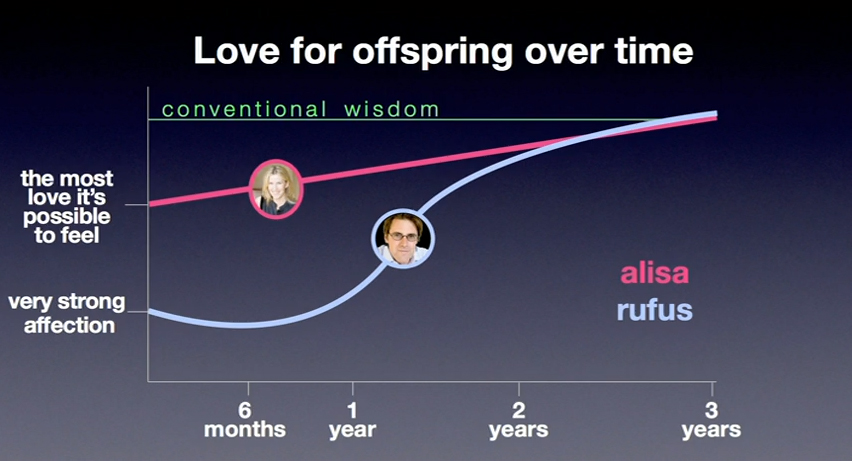
That moment in the car reminded me of a TED Talk given by Rufus Griscom and his wife Alisa Volkman (founders of Babble.com) entitled, “Let’s talk parenting taboos” where the couple playfully charted the love each of them have felt for their own offspring over a period of 3 years in a PowerPoint slide.

Source: Rufus Griscom & Alisa Volkman, TED Talk “Let’s talk parenting taboos

From looking at their chart you can see that for Rufus, love was not instant as society often implies it will be, but rather it is a process as he mentions in his talk. Even Alisa, who charted the most love possible to feel for her child at birth, noticed that her love still continued to grow stronger as time went on again confirming again that love is indeed a process.

As an adoptive parent, I wonder what my love line for my son would look like and what might my son’s birthmother’s love line look like? I also wonder if being around the child or knowing them is necessary for the love that you feel toward them to rise? I suspect my line would begin closer to Rufus’s line (since I knew little about our son at the time of his birth and had lacked bonding time with him during the pregnancy phase) and then would continue with a steady rise as I got to know my son more over time. After 4 years of caring for my boy, I believe that my love toward him equals any parent’s love for their child; as an adoptive parent who once feared this intensity of love might not ever be possible this is a very rewarding feeling. It’s hard to imagine my love growing any stronger than it is now but time will tell if it continues to expand even more in the years to come.

Adoptive mother: Reconnecting with family via adoption

When you live 3000 miles away from your family for more than a decade with little to no ongoing contact with your extended relatives, relationships tend to suffer. Closeness you might have felt at one time toward a person begins to fade despite your best intentions to keep a strong relationship going. You simply can not maintain healthy contacts with people if you never see them and rarely speak to them. Such was my predicament with my extended family in New York state and in other parts of the country before our son was born. I remember visiting with my New York cousins once at Christmas time years ago when a cousin’s spouse raised the question, “How are we, the cousins, going to stay in touch over the years?” The question was dropped over the dining room table like a bomb but I remember nobody had a definitive answer. The truth was, I wanted to be closer with my family but I didn’t know how that would happen living across the country from them.

Well the Universe must have heard my silent plea for help because when we finally got “The Call” that a birth family selected us to adopt their child, we learned that they happened to live in New York state just 15 minutes from several of my relatives on my mother’s side of the family, and only an 1 ½ hours from my parents house! I was astounded at our good fortune. The laws of many states, New York not excluded, require you to be in the state for a minimum of two weeks period so the birth parents have adequate time to sign legal paperwork which will take away their rights to parent their child forever. I ended up spending a lot of my time in New York reacquainting myself with much of my maternal side of the family.

It wasn’t just the maternal New York relatives that I began reconnecting with via my son’s adoption either but my Dad’s side of the family as well. When my Aunt and Uncle in Connecticut heard that we were beginning the adoption process they were very encouraging as they had acquired both of their children (my cousins) in closed adoptions years ago. My Aunt in particular, was very supportive throughout the process and began regularly checking in on me, mostly via email but sometimes by phone. Her support was especially appreciated during our long wait to adopt since she herself was not a stranger to the pains that infertility and adoption can bring. So the mere fact that we were adopting a child as well gave me a sense of connection to my paternal Aunt and Uncle that had never existed before.

During the two weeks we were actually in New York state, going through with the adoption my husband and I needed many things: a place to stay, a car, a crib, a car seat, a stroller, diapers/wipes, baby blankets, and a few articles of clothing. ALL of these necessities and more were provided to us with love by my relatives. (Many adoptive families spend a lot of money on a place to stay and car rental costs during this period.) My husband, myself and our newborn son were showered with generosity. The crazy thing is, had we ended up birthing a biological child we would have had a much smaller support group as we would have been in California, 3000 miles away from most of my family, plus none of the rekindled family connections would have ever taken place.

Our extended relatives STILL (four years later) talk about the time around our son’s birth because so many of them had some part of it. Just this last month, when I got together with some family members from New York, one Aunt in particular says that she feels a special bond with our son, for a time more so even than with some of her own grandchildren, and she will forever remember the weeks when we stayed with her as it was such an amazing and special time. Today, on my son’s fourth birthday, I can’t help but marvel at those events which forever impacted our new family. Our little boy, by being adopted and being born where he was, inadvertently removed all the feelings of isolation I had once felt toward my extended relatives on both sides of our family – for this amazing feat I am eternally grateful.

Birthmother: Eight years and counting

By Birthmother – Today is May 11, 2015. My first child, Catherine, will reach 8 years of age in August.  My second child will be turning 4 this very month.  These children are both fully and undeniably planted in their families, rooted into their own lives with their own routines, functions and dysfunctions, pains and joys.  Their lives are healthy.  This is what adoption allows us to accomplish!  Amen, praise God, and hallelujah!  I’ve posted my excitement and pride about adoption before, and I will most assuredly post it again.  There is so much uncertainty before an adoption takes place (as I’m sure you know), so many decisions to make.  What a relief to see that somewhere down the road the pieces begin to fit into place.

But as I stop to consider the passage of years I must not hesitate to mention the one person who, by choice, is not necessarily “planted” in these families: me, the Birthmother.  With each year that passes I become more of a stranger, and the process of staying in contact becomes more strange.  My open adoption contracts ensure that I will never completely lose track of these families, but distance ensures that my maternal connection to the children I carried will grow more faint each year.  Distance is the one reality of adoption that each birthparent must truly be willing to face.  My biochildren are very far away.  Our lives are very far apart.

Does this sound tragic?  It isn’t.  It may be painful, but it isn’t tragic.  The important thing to remember is that distance can be healthy for everyone involved.  Distance allows the adoptive parents to grow secure in the fact that they are THE PARENTS.  They need to know that their position of authority is sound.    Distance allows the children to grow up in their own ordinary, everyday lives without being bogged down by their (sometimes very confusing) heritage.  Distance allows birthparents to feel safe their own decisions and to carry on the processes of building their lives.  In fact, I purposefully chose birthparents in far away states to ensure that healthy distance would exist.  As much as I believe that I will never become the tragic biomom stereotype who changes her mind and tries desperately to get her children back, I do not want to be faced with such a temptation!  Hormones are strong, my readers; studies show that frequent interaction with a child can trigger parental behavior in just about everyone.  Don’t worry, folks: the laws of our country are increasingly changing to protect the children and their adoptive families from any such tragedy, hormones or no hormones.

OK, so I’ve established that the distance between me and the adoptive families is healthy.  What about contact?  Almost every adoption site will list GREAT reasons for keeping an adoption open (the list at http://www.adoptionhelp.org/ includes avoiding the consequences of secrecy, encouraging open communication, and acknowledging the fact that children will always be related to their birthparents).  From what I understand, the benefits of an open adoption are strongest for the children being adopted.  An open adoption makes an adopted child’s heritage more transparent for them, with less feelings of doubt or shame later in life.  But what feelings arise for the parents in the meantime?  That’s what I’m learning about right now!  For instance, I’ve had a few questions on my mind this month.

Question 1: Do I persist in staying in contact when the adoptive families are ambivalent about my presence?  Catherine’s adoptive father explained to me recently that by this point in our journey he “feels like there is a hurdle that has been passed.”  He doesn’t dwell much on the subject of adoption one way or the other.  Catherine is his daughter.  What’s done is done.  (Isn’t his sense of security amusing in contrast to the constant questions and feelings that Karen and I express on this site? Ha!)  So if the metaphorical adoption hurdle is passed… where does the biomom fit in?  To help you understand the feeling, imagine being a far-removed aunt or cousin who insists on sending birthday cards and Christmas letters, seemingly oblivious to the fact that she is nothing but a footnote in the lives of the people she contacts.  I know, I know, I’m more than a footnote in the grand scheme of things, and the adoptive parents care for me very much.  I’m not discounting their attention to me.  What I’m trying to say is: I feel like I don’t belong!  I fear that my very existence might undermine the happy, ordinary lives that my children have found!  As much as I want to keep in contact with Catherine, I have no idea how much contact or what kind of contact to give. But I can’t let my own insecurities (or those of the adoptive parents) stop me from doing what I hope will be best for the children.  So I continue to send presents and letters to my biochildren on their birthdays and at Christmas. Which brings me to…

Question 2: What (if anything) do I say to a child who doesn’t know me? Yes, Catherine and my son know that I exist.  Open adoption helps with this.  But let’s be real – I’m not there every day (or every month, or every year).  From the perspective of a 4 year old child (or an 8 year old child), what is my relevance?  I’m not too concerned about this question right now.  When I was 8 years old, I thought that getting letters was pretty much the coolest thing ever.  I had many pen pals.  I don’t think it would have mattered to me if the person writing the letter was a friend, or an aunt, or a biomom, or a second cousin twice removed.  So, I’ll write about whatever pops into my head and hope for the best.

I will continue to post my feelings and questions here, as will Karen, but our stories are only two out of THOUSANDS.  Our stories will not be yours.  If you have questions about which type of adoption is best for you, I encourage you to connect with an adoption agency or support group for more information.  Ultimately, only you know what your preferences are.  And guess what: your preferences may change over time, long after the paperwork is signed!  How troublesome is that?  At least an open adoption leaves some room for adaptation.

I suspect that no matter what you choose you will eventually find yourself like me, trying to navigate within the reality of your very unique adoption experience.  There isn’t an etiquette book for this (the parents who adopted baby Catherine and I learned this very quickly)!  Sooner or later you will find yourself with questions that no one but you can answer.  Truly, I wish you the best of luck and all the blessings that God can bring.

Adoptive mother: Fearful of being open

In preparation for launching my blog I talked with close family members and friends about going public with these columns and to my amazement, the fear that many people associate with the mere concept of open adoptions has come to the surface once again simply by stating that I’m going public with my blog. My family insists that their fear is in regards to the privacy of other people involved in the adoption – particularly my son and his birth parents; they want to be sure that I maintain their privacy rights. However, I suspect that the underlying issue here is a different one, especially since I told my family that I took great pains in my blog to omit my son’s name and to change names of birth family members to maintain their privacy. I believe their trepidation is over my own exposure in talking so publicly about some very sensitive issues of an open adoption and not knowing what the impact of that might be and their desire to protect me.

Yes I understand they are worried about me – I get that; however I’ve already been exposed. For two years my husband and I were fully and completely exposed to the world in a way that nobody would understand unless they themselves have gone through an open adoption. Heck, we launched a website about us and had a brochure circulating both of which showed pictures of us and outlined who we are, what kind of house and environment we live in, our interests, our intentions in bringing a child to our home, and many other details about us that I would have preferred to keep private. As far as I’m concerned, I’m ALREADY out there!

I remember very well the same fear surfacing from some people when I first told them I was going to do an open adoption in the first place. “An open adoption? Are you sure that’s a good idea? Aren’t you afraid the birth parents will take the baby back?” While going through our open adoption placement I had to stop listening to these fearful comments from others and go forward anyway. If I’d let their worries dictate my actions I never would have adopted my son and formed the wonderful relationship I have with his birth parents.

Other people have pointed out to me that perhaps a generational difference is at play in the fear of exposure and in being candid about the adoption. Years ago open adoptions were not common at all; in our generation they are becoming more standard. Although many potential adoptive families still need an adjustment period to warm up to the idea of open adoptions, we are evolving as open adoptions become more and more accepted. People today are more accustomed to having their privacy exposed via the internet and social media. Our parent’s generation didn’t have that in their everyday lives.

Whether or not this generational gap is true or not, I feel very strongly that by exposing myself by sharing my stories, stories of our experiences over the years, other people could see what is possible with open adoptions. I refuse to use an alias for my name as some people have suggested. If I am not willing to be open about my experiences (the good and the bad) exposing who I am then how will other people learn and benefit? How will the stigma of an open adoption ever be changed? And after all, isn’t being open what an open adoption is all about?

Adoptive mother: Accepting without blame

My 3 ½-year-old son is squarely in his toddlerhood. He is at the age where he is super cuddly, sweet and playful; he gives the best hugs and kisses; he’s super fun to play with and chase; and he is also right in the center of one of the hardest tantrum years. Yea – forget the terrible twos, anyone who had a toddler child will tell you the threes are where it’s at. He challenges us daily. He is very demanding now about what he wants, which is great that he is seeking out his independence but not so great when we try to get him to do anything where he has a different agenda than ours.

If he doesn’t get what he wants when he asks for it you can guarantee there will be lots of whining, manipulating, begging and often crying. All of that is annoying as heck but stuff that I can handle. It’s the escalated version of this tantrum which follows, not always, but on occasion, that is concerning to me. If a tantrum goes too far or if our son feels physically threatened in any way he is flat out violent and completely out of control with physical rage. He will try to hurt me (or my husband, or whoever else is ‘threatening’ him or getting in his way) and it is all we can do to hold our son down to keep him from hurting us during these times. It’s a crazy wrestling match between me, a grown adult, and my boy, a 34 pound toddler. When I’m alone with him during these times it takes all of my physical strength to ward off my son’s blows and bites and it terrifies me to know that if he gains just a few more pounds he might actually start winning these matches! Both my husband and I have consulted with our parents about his violent tantrums to ask if either or us had ever given them any trouble is this area in our childhoods and neither us (nor our siblings) had been so violent. We certainly were not angels in our toddlerhood but we were not violent children; this territory is completely unfamiliar to us and our families. Our son’s very demanding and aggressive behavior has led me to utter the phrase more than once to my husband “If this were our biological child we would not be dealing with this!”

This statement causes my husband to roll his eyes at me. I’m aware that it is completely ludicrous and completely unfair to our son’s birth parents. The stone throwing quote from the Bible fully applies here completely even though I’m am not one to normally quote the Bible: “Let any one of you who is without sin be the first to throw a stone at her.” John 8:7  This most simply translates to: my genetic history isn’t perfect either so basically shut my pie hole! But I don’t care about any of this rational sometimes. What I want is to scream out at the top of my lungs, “I HATE THIS! I’m not equip to deal with this behavior and I didn’t ask for this! A biological child of mine would NOT be acting like this!” I want to blame someone for my adopted child’s violent and demanding behavior because deep down I think it might somehow make me feel better and less like an inadequate parent who has no idea how to deal with her child.

But my logical rational knows something different. I’m well aware that traits in children can sometimes come out of nowhere. Parents with no family violence in their history can have a violent biological child. Parents who are perfectly healthy have disabled children, kids with autism, kids with ADD, or any number of any undesirable traits that they didn’t expect. One may not ever know where a characteristic of a child comes from. But even if our son’s violent tendencies do come from his birth family, who am I to cast the first stone.

I begrudgingly remind myself that had we had our own biological child we might not be dealing with anger management issues true, but rather a whole slew of other problems and there would be nobody to blame. There would likely be autoimmune issues, skin cancer issues, tendencies toward depression and other mood disorders, horrible acne in the teenage years, infertility issues later in life, just to name a few things on my side alone. And what then? Pointing fingers at myself or my spouse for these things would be completely unproductive.

What I am trying to learn as a parent, not just as an adoptive parent, is that there is no room for blame in parenting. Yes, some traits might be inherited from the birth family, in which case, can an adoptive parent of an open adoption swallow their pride and touch base with the biological family members to work together to come up with possible solutions for their child? If the adoptive parent does not feel comfortable approaching the birth family, or does not have access to the birth family, what can they do in the present to help their child? We must use all resources available to us; and like all families, biological or not, we must learn to accept what is in a person, without blame, and move on from there and try to focus our attention on the bright side: marveling at how amazing it is that each or our children are all their own very unique persons.

Adoptive mother: Clearing up misconceptions

There are two reasons why I am writing columns back and forth with Lizzie, our son’s birthmother. The first is to understand what Lizzie thinks and feels in certain situations because I believe this knowledge will help me be a better adoptive parent to our son later on when he starts asking me questions about his birth parents and adoption. The second reason I want to write columns back and forth with her is to potentially educate other people on open adoptions, clearing up many misconceptions and showing them how dynamic relationships between adoptive parents, birth parents and children can be.

I do sometimes fear that I might write about things or issues that might be painful, disappointing or sensitive to Lizzie. It is a risk writing some columns because I’m being very honest and personal with my feelings and I don’t always know what angst certain topics might cause her or whether or not I’m opening up a wound she is trying to heal. I imagine she must feel the same when writing about topics from her perspective as well, being fearful that I might feel threatened by her or perhaps not like something she has to say. Even though our adoption is an open one there is still much I do not know about my son’s birthmother and how she might feel in regards to situations surrounding our son’s adoption.

Recently, I felt great angst after sharing a column with Lizzie titled ‘Introducing Catherine.’ In the column I revealed telling our son (now 3 ½) for the first time about the existence of his sister, Catherine. Shortly after sharing this column with Lizzie I noticed that she had posted a couple of somewhat gloomy Facebook postings admitting she was going through a difficult time. In addition, unlike Lizzie, I received no email response about the recent column I had shared with her. My monkey mind immediately jumped to the conclusion that I had upset her with my Catherine article – knowing that she hoped someday for her two biological children to know each other, and that my article saying we were just now telling our boy about his sister surely distraught her. That must be the reason for her gloomy, depressed mood so I thought.

Come to find out, her depressed state had nothing at all to do with my article or anything about our or Catherine’s open adoption for that matter. Had I not felt comfortable enough with our relationship and written her to specifically ask if I had upset her with my article I would have kept assuming, incorrectly, that her dismay was all about us. This incident makes me so grateful that Lizzie and I do indeed have a very open running dialogue going via email and these columns. I’m so blessed to have access to this very private part of her life. I wonder how other adoptive parents make sense of miscommunications that sometimes happen through open adoptions? Would they wonder continually like I did that birthmothers spend much of their time pining over their “lost” child? Or fear continually that deep down the birthmother must want their child back?

Despite what we might think, her life is not all about our adoption. She struggles with other things. I’m guessing I’m not the only adoptive parent who is surprised by this, not that I don’t see the logical rational behind it; I see our son every day as a reminder of our adoption where she does not. Other adoptive parents might think similarly to me; perhaps they too always have a feeling that their birthmother must be regretful at times in regards to her child’s adoption which causes her depression in life. I’ve learned to not really question whether or not the regret is there, but rather question how much regret is there.

Through this recent exchange with Lizzie I’ve learned a very valuable lesson. As an adoptive parent it is important to remember that our adoption is not always on center stage in the live’s of our child’s birthmothers despite any regret she might feel over placing her child for an adoption. As much as adoptive parents might think and fear that all the birthmother ever does is long for and pine away for their child(ren) making her depressed, this simply is not the case.